
Prevention
Prevention of HIV and STI infection is one of the important components of National AIDS and STD Control Programme (NACP). The NACP Phase V (2021-26) aims to reduce annual new HIV infections thereby envisaging that people who are at risk of acquiring HIV infection use comprehensive prevention and access quality STI /RTI services (NACO, 2022). Aligning with the above, various prevention strategies are initiated by National AIDS Control Organisation (NACO) to provide prevention services primarily among the High-Risk Groups and other vulnerable population who are at risk of acquiring HIV/STI infections. The high-risk groups (HRG) include Female Sex Workers (FSW), Men who have Sex with Men (MSM), Hijra/Transgender persons (H/TG), People Who Inject Drugs (PWID) and the Prison Population. Migrants and Transport workers are considered as bridge population staying between the HRGS and general population and covered under various projects and initiatives. Prevention services are provided to the above population primarily through projects like Targeted Intervention (TI) and Link Worker Schemes (LWS) and activities in Prison and Other Closed Settings (P& OCS) and through Sampoorna Surakhsha Strategy (SSS).
TI and LWS are implemented in partnership with Non- Governmental Organisations (NGOs) and Community Based Organisations (CBOs) contracted through State AIDS Control Societies (SACS) under the Social Contracting Mechanism of NACP. To ensure comprehensive prevention services, NACP adopts new approaches and strategies to reach the unreached and last mile community members through a Peer-led, outreach based model that offers a package of prevention, support, and linkages services. The TI projects are aimed at reaching out to HRGs and Bridge populations operating in urban or semi urban areas. Similarly, the rural HRGs and vulnerable populations are covered through LWS. In addition, NACP has laid emphasis to reach the inmates in Prison and other closed setting (P& OCS) with HIV and other health related services. Focus is given to reach out to the spouses and partners of HRGs and sub-groups of high-risk population who are active on the virtual platforms. It also involves expanding and intensifying the coverage of HRGs and Bridge Population, OST among injecting drug users and coverage of ‘at-risk’ HIV negative through comprehensive prevention packages to keep them negative through Sampoorna Suraksha Strategy (SSS). Community System Strengthening (CSS) acts as enablers to the overall prevention strategies to augment and achieve the goal of ending the AIDS epidemic by 2030. The prevention initiatives and projects are scaled up and are designed based on the evidences generated from the Mapping and Population Size Estimation (PMPSE), programme data, field intelligence, community feedbacks, HIV Sentinel Surveillance (HSS) and the inputs from the Technical Resource Groups through a consultative process (ICTC, STD clinics).
Major prevention interventions for HIV/STI services under NACP.
Targetted Intervention Projects (TI)
TI Projects are implemented through Non-Governmental Organizations (NGOs) and Community-Based Organizations (CBOs), contracted by respective State AIDS Control Societies (SACS) under the Social Contracting Mechanism of NACP. The selection of target groups and strategic locations for TI interventions are decided based on the programmatic mapping and population size estimates and field intelligence. Every TI project comprises of a Project Manager, Counsellor, M& E cum Account Officer, Outreach Workers, and Peer Educators based on the number of HRGs allotted, etc. Peer educators are engaged from within the community to strengthen the outreach and service delivery arms of the TI projects. Drop in Centres (DIC) are established under the TI projects to provide communities a safe space, offer clinical services, counselling, commodity provisions (Condoms, N/S, lubes etc.), conduct other social and behavior change communication and capacity building activities and referral services. TI outreach team prepare micro plans for providing services and update the plan periodically to optimize their outreach services. Monthly meetings are conducted at TI level to see the overall progress, gaps and prepare the next month activity plan. State wise list of TIs as on Dec 2024.
Interventions in Prison and Other Closed Settings (P&OCS)
NACO’s prison intervention program is designed to address the heightened risk of HIV transmission in prisons and other closed settings (OCS) due to overcrowding, risky behaviors and limited access to healthcare. The program provides comprehensive HIV prevention, treatment, and care services tailored to the needs of the inmates. Key services include HIV screening and counseling, Antiretroviral Therapy (ART) provision, health education on HIV and related infections, and the distribution of condoms. Additionally, referrals are made for continued care post-release. The program also treats other diseases such as tuberculosis, sexually transmitted infections (STIs), and Hepatitis B and C, ensuring a holistic approach to inmate health and reducing the burden of communicable diseases within these high-risk environments.
Link Workers Scheme (LWS)
The Link Worker Scheme (LWS) is designed to bring HIV prevention, care and support services to rural areas, addressing the needs of high-risk groups (HRGs) and vulnerable populations who are often underserved. This scheme specifically targets Female Sex Workers (FSWs), Men who have Sex with Men (MSM), People Who Inject Drugs (PWID), Hijra/ Transgender, People living with HIV (PLHIV) and vulnerable groups like migrants and truckers, Antenatal cases, Persons with Tuberculosis in rural settings. The primary objective is to bridge the gap in HIV services by providing these populations with access to screening, counseling, treatment and support. The scheme employs link workers from the community who are trained to conduct outreach, provide information and facilitate access to health services. These link workers play a critical role in identifying individuals at risk, conducting interpersonal communication, distributing condoms, and ensuring referrals to HIV screening and treatment centers. The scheme also involves community mobilization and capacity-building activities to strengthen the local response to HIV. By leveraging local resources and community networks, LWS ensures that rural populations receive comprehensive and continuous HIV related services, thus reducing the burden of the epidemic in these hard-to-reach areas. The LWS is implemented through NGOs/CBOs contracted through respective SACS under the social contracting mechanism.State wise list of Link Worker as on Dec 2024.
Service Delivery Components under Prevention (TI)
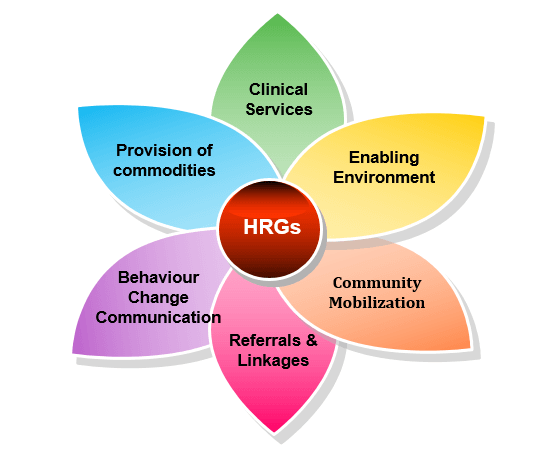
Service Package provided to HRGs and Bridge Population under different Components
| Service Components | Services / Activities |
|---|---|
| Behavioural Change Communication (BCC) | Counselling for behaviour change, Interpersonal Communication (IPC) by peers and ORW, Field-Level events/melas, Condom demonstration cum training on condom usage, negotiation skills and usage of needles (for IDUs only), NACO Help Line |
| Commodity Provisions | Free condom & Lubricant distribution, Social marketing condoms, Clean needles/syringe for PWID, Community Mobilization |
| Community Mobilization | Reach out to the community through outreach workers (ORW) and Peer Leaders, Capacity building of communities to own the programme |
| Clinical Services | Regular Medical Checkups, Treatment Sexually Transmitted infections (STIs), Syphilis Screening, Community Based screening for HIV, Opioid Substitution therapy, Abscess Management (for PWID) |
| Referrals & Linkages | Integrated counselling and screening Centres (ICTC), Anti-Retroviral therapy (ART) Centres, Enrolment in Social protection schemes through various line departments |
| Enabling Environment | Sensitization, Advocacy and liaison with key stakeholders |
Clinical Services provided under TI as per NACO Guidelines:
- HIV & Syphilis Screening and Testing Services
- Bi-annual HIV & Syphilis testing of HRGs using Dual Kits and post-test counselling
- Community Based Screening (CBS) to improve early HIV case detection by offering HIV testing in community settings
- Referral to ICTC for the confirmation if found reactive
- Linkage to ART centres if found positive
- Treatment with Benzathine Penicillin (BP) as per STI/RTI guidelines
- Regular Medical Check-ups for STI/RTIs
- HRGs are provided with regular medical checkup once in a quarter at TI Static clinic or through PPP clinic or Designated STI/ RTI Centers (DSRC).
- The symptomatic and asymptomatic cases are treated using the syndromic case management approach, as per NACO guidelines and provided follow up services.
- Presumptive treatment for STI/RTIs are provided to all newly registered screening twice in a year
- Abscess & Overdose Prevention & Management for PWIDs
- Prevention counselling and management of injection-related abscesses for PWIDs
- Prevention counselling and management of drug overdose with opioid antagonist Naloxone as part of crisis response mechanism
- TB screening and referral under National TB Elimination Programme (NTEP)
- TB verbal screening for all HRGs and referral to DOTs
Commodity Provisions under Prevention Strategy
Condoms: The provisioning of condoms is one of the important pillars of National AIDS and STD Control Program for prevention of further transmission of HIV, STI as well as other viral diseases like Hep B and C etc. Condoms are distributed through facilities like Targeted Interventions, Integrated Counselling and Testing Centres, Designated STI RTI Clinic, Anti-Retroviral Treatment Centres, Care and Support Centres and newer centres like Sampoorna Suraksha Kendra, One Stop Centres etc under NACP. Condoms are supplied through Ministry of Health and Family Welfare- Free Supply Scheme.
Needle Syringe Exchange for PWID : The provisioning of new needles and syringes is one of the key harm reduction strategies for prevention of transmission of HIV, HBV,HCV and other infections among the people who inject drugs (PWIDs) and also serves as an entry point for accessing other health services such as HIV, Syphilis and STI screening and treatment, behaviour change communication, psychosocial counselling and treatment for substance use disorders. The NSEP program primarily involves education and distribution of new needle/syringes to PWIDs to reduce HIV infections through sharing of infected needles and the used needle syringes are collected in return for disinfection, removal from further circulation, and disposal as part of the standard bio-waste management services.
The services under the TIs are implemented through a three –pronged approach of peer based outreach, static Drop in Centres (DIC) and referral and linkage and includes clinical services for HIV, Syphilis & STI as well as regular medical check- up, abscess management, overdose prevention and management. Additionally, the PWIDs registered under the TIs are further counselled to take up treatment services for substance use disorders at the Opioid Substitution therapy centres.
Opioid Substitution Therapy (OST)
Opioid Substitution Therapy (OST) is a vital harm reduction strategy designed to address the health risks associated with injecting drug use, particularly among People Who Inject Drugs (PWIDs). These individuals face significant dangers, such as the transmission of HIV, Hepatitis B, and Hepatitis C, due to sharing of infected needles and syringes. The vulnerabilities of PWIDs are further heightened by various socio-economic and psychological factors, making them more susceptible to these health risks. To mitigate these dangers, OST is implemented as part of a comprehensive harm reduction approach under the National AIDS and STD Control Programme (NACP). OST involves administration of long-acting opioid agonist medications through the sublingual route, which helps to stabilize opioid dependent users by reducing cravings and withdrawal symptoms, thereby enabling the patient to stop injecting drugs and remain abstinent from illicit opioids and regain a stable life. The therapy is combined with psychosocial counselling and is a cornerstone in reducing the transmission of HIV and other blood-borne infections among PWIDs.
OST is primarily delivered through a “Directly Observed Treatment” model in clinic-based OST Centres, overseen by a Medical Officer. For stable clients, a provision for outpatient take-home doses are also provided. The OST program is offered through three distinct models: The Collaborative Model at public health facilities, the NGO-Based Model at Targeted Intervention NGOs, and the Satellite Model in various community health settings such as PHC/Health & Wellness centres etc. as well as prisons and other closed settings.
In addition to the pharmacological intervention, counselling and support services remain essential components of this strategy, addressing the underlying psychological and socio-economic issues that contribute to drug use. By ensuring access to comprehensive healthcare for PWIDs and their families, OST supports both immediate health needs and long-term recovery, making it a critical tool against drug-related harms.State wise list of OST as on Dec 2024.
Other Prevention Intervention/Innovations
One Stop Centre (OSC)
The One Stop Centre project is a new initiative implemented under the Global Fund Grant (2024-26) with the focus to provide the comprehensive package of health services services to key population groups including Hijra / Transgender Persons & People Who Inject Drugs ((H/TG & PWID) and Bridge populations in community settings. For details:
Selection of NGOs/CBOs under NACP
| S.No. | Title | Attachment File |
|---|---|---|
| 1 | Revised SOP of NGOs/CBOs Selection to Implement Interventions/Projects in States/UTs under NACP 2022 | Download (1.72 MB)  |
| 2 | Social contracting under NACP in India- 2019 | Download |
| 3 | Project Norms and ToR TI_LWS NACP V | Download (788.26 KB) |
| 4 | Revised TI_LWS budget norms NACP V | Download (1.46 MB) |
| 5 | NACO Guidelines on financial & Procurement system for CBO’s/NGO’s-2007 | Download |
| 6 | NACO Guidelines on financial & Procurement system for CBO’s/NGO’s Annexure 1-2009 | Download (18.81 MB) |
Monitoring & Evaluation
| S.No. | Title | Attachment File |
|---|---|---|
| 7 | Revised Manual for Evaluation of TIs 2019-20 | Download |
| 8 | Revised Evaluation Tools for All Typology-2020 | Download |
| 9 | Guidance document for conducting Six monthly appraisal of Targeted Intervention (TI) Projects under NACP – 2023 | Download (788.26 KB) |
| 10 | Guidance document for conducting External Evaluation TIs & LWSs | Download (788.26 KB) |
TI/LWS Operational Guidelines
| S.No. | Title | Attachment File |
|---|---|---|
| 11 | Guidelines for Intervention among Rural HRGs and Vulnerable Population (Link Worker Scheme 2.0) | Download |
| 12 | SoP for reaching the unreached HRGs operating at Spa_through Network Operators_at web based platforms under NACP- 2024 | Download |
| 13 | Revamped and Revised Elements of Targeted Intervention- 2019 | Download |
| 14 | Targeted Intervention Revamped Strategies- National Training of Trainers- 2019 | Download |
| 15 | Guidance Document on TB-HIV Linkages for Targeted Intervention and Link Worker Scheme-2018 | Download |
| 16 | Operational Guideline for implementing TIs for TG – 2015 | Download |
| 17 | Operational Guideline for implementing TIs for MSM-2015 | Download |
| 18 | Targeted Interventions Under NACPIII Core High Risk Groups – Operational Guidelines , Volume III-2007 | Download |
Bridge Population-Migrants & Transport Workers & Other Vulnerable Populations
| S.No. | Title | Attachment File |
|---|---|---|
| 19 | Guidelines for Intervention among Bridge Population under NACP – 2023 |
Download |
| 20 | Guidelines For Organising Intensive Health Camps And Communication Activities In Out Migration Districts-2012 | Download |
| 21 | Truckers Mapping Report -2007 | Download |
People Who Inject Drungs (PWID)/ Opioid Substitution Therapy (OST)
| S.No. | Title | Attachment File |
|---|---|---|
| 22 | Clinical Practice Guidelines for Buprenorphine based Opioid Substitution Therapy under NACO 2021 | Download |
| 23 | Standard Operating Procedure for Buprenorphine based Opioid Substitution therapy under NACO – 2021 | Download |
| 24 | Buprenorphine-based Opioid Substitution Therapy Under National AIDS Control Organization-A Training Manual for Service Providers- 2021 | Download |
| 25 | Opioid Substitution Therapy- Feasibility Assessment Report (for all facilities) | Download |
| 26 | Technical Specification Committee for revision of technical specifications of plain Buprenorphine and Buprenorphine + Naloxone Tablet under National AIDS Control Program-2023 | Download |
| 27 | Report of the National Consultation on Health Interventions for Substance Use Disorders–September 2024 |
Download |
Prison & Other Closed Settings Intervention
| S.No. | Title | Attachment File |
|---|---|---|
| 28 | Operational Guidelines on HIV/STI/TB and Hepatitis Intervention in Prison & Other Closed Settings- 2023 | Download |
| 29 | Training Module for Health Care Providers in Prison & Other Closed Settings-2023 | Download |
| 30 | SOP for Management of Integrated Interventions for STI, HIV, TB & Hepatitis in Prisons and Other Closed Settings-2024 | Download |
| 30 | Strategy Document for Convicts and Under Trials under Prisons & Other Closed Settings Intervention | Download |
| 31 | National Dissemination of ISHTH Campaign & Review Meeting of Prison and Other Closed Settings Intervention 21st and 22nd March 2024 |
Download |
| 32 | National Consultation and Review Meeting of Prison & Other Closed Settings Interventions-19 th -21 st May 2022 | Download |
| 33 | Fact Sheet 2023-24 – Prison & Other Closed Settings Interventions | Download |
| 34 | Revised Technical Specifications of free condom artwork, labelling and packaging under NACP –V, dated 5 th September 2023 | Download |
| 35 | Reconstitution of National Working Group (NWG) for forecasting of commodities under BSD, STI & Prevention Division of NACO-2 nd August 2023 | Download |
Health Camps- Integrated STI, HIV, TB & Hepatitis(ISHTH) Campaign & Integrated Health Campaign (IHC)
| S.No. | Title | Attachment File |
|---|---|---|
| 38 | Standard Operating Procedure (SOP) for Integrated health campaign through Hybrid Approach in priority districts-2023 | Download |
| 39 | Guidelines for Organising Integrated STI, HIV, TB and Hepatitis (ISHTH) Campaign in Prisons & Other Closed Settings, Drug Rehabilitation Centres and Juvenile Homes-2023 |
Download |